Tuesday, 13 September 2016

Sarah Ellen's Story - 1861-1938 - (my Maternal Great Great Grandmother)

Sarah Ellen Simpson


My Mum's genealogy research began almost 30 years ago, when my eldest brother, Dan, was back in the home of our forbears and studying at Newcastle University.  It seems a good place for me to pick up on the story of Sarah Ellen who was born on 15 October 1861, the second child of Grocers, Joseph and Isabella Carr of Batley, West Yorkshire.


Sarah Ellen travelled to Jarrow for a career as Assistant Teacher in a Board School, where she lodged in the home of the Headmaster and his wife.  Board Schools provided elementary education for children from 5 to 13 where there was a shortfall in places. In 1881 parents still had to pay fees for their children to attend schools.  Religious teaching in board schools was restricted to non-denominational instruction, or none at all.

Sarah Ellen & John Matthew Gray

On 18 September 1887, Sarah Ellen married farmer John Matthew Gray of Red House Farm (now a residential area of Newcastle upon Tyne).  She was thrilled to become a farmer's wife and studied farm husbandry, dairy hygiene and revelled in cooking.  A son, John Thomas was born on 20 September 1888.


John Thomas & Annie Emmeline

Sadly, Sarah Ellen's husband, my Great Great Grandfather, John Matthew Gray, died age 35, of Typhoid Fever in April 1890, just a short time before the arrival of their daughter, Annie Emmeline.  Only three years later, Sarah Ellen's life was totally shattered when Annie Emmeline also died of Typhoid Fever.

At only 26, Sarah Ellen held on to the rented Red House farm and is quoted as 'The Farmer' in Ward's Directory in 1880.  Ward's Directory was a trade directory for Newcastle upon Tyne, that listed all businesses and tradespeople, as well as a general directory of postal addresses of local landowners, charities, and other facilities. In effect, it was a Victorian version of today's Yellow Pages.  In the 1800's it would be less usual for a female career to be acknowledged.

According to the 1891 Census, she was supported on the farm by live in hands Bridjet Mary Cain, a Domestic Servant from Ireland and a Farm Servant called Walter Lilley.  Boarding lodgers employed in the nearby dockyards brought in extra vital income.


In March 1896 Sarah Ellen married George Charlton, a 60 year old farmer of Ricklees Farm (another now residential area of Newcastle).  The story passed down has it, that George made a cruel stepfather to young John and Sarah Ellen was very unhappy - although my Granny also heard it said that Sarah Ellen adored young John so much, she could not reason any discipline - maybe quite fairly considering her earlier losses.  

George squandered all Sarah Ellen's livestock and money.

One morning, while John was safely staying with his Grandparents in Batley, Sarah Ellen, packed her ottoman trunk with special possessions (including items still in the family, cranberry glass, meat plates, silver spoons and a small black mirror) and hid it under the delivery of farm eggs bound for Newcastle.  The Cart Driver dropped her off in Newcastle, but before the driver of the cart could do anything about it, she smashed all the eggs on the cart, leaving George virtually penniless.

Sarah Ellen & young John

Sarah Ellen found work in a restaurant with generous couple, Cuthbert and Isabella Saul. By 1923 she put her culinary skills to the test in her own 'Gentleman's Restaurant' and billiard room.

The proportions in Sarah Ellen's recipe book confirms Monument Cafe on Blackett Street must have been a popular spot - 'Vegetable Hotpot - 50lbs potatoes, 3lbs onions, 6 Oxo cubes, pepper & salt.  Pastry: 4lb flour, 2lb ground rice, 1/4lb marg, 1 1/2 oz baking powder.'  The recipe notebook contains hundreds of thrifty recipes providing good wholesome nourishment.

Sarah Ellen Gray
Sarah Ellen died in January 1938 and was cremated in Newcastle as Sarah Ellen Gray, though her death certificate uses her second married surname, Charlton.

You may wonder what became of my Great Grandfather, young John Thomas (Jack) Gray, MBE?  He may well be the subject of my next blog.

Blackett Street, Newcastle, circa 1900

Sarah Ellen's book of recipes


Ward's Directory Cover from 1850

Tuesday, 16 February 2016

Who do you think you are?

I love the series  "Who do you think you are?", I've watched every episode since it began back in 2004.
Victoria (Mum), Emma (my daughter) & Me
My Mum caught the genealogy bug a number of years ago, and now I am curious and ready to know the yarns she has revealed.  One week in February 2016, my husband, John (oh, she's done his too!) is away with work, so this seems the perfect time to take a day off with Mum to look at her research.

I suggest we start with a story I vaguely recall and my own memory of serving "Sarah Ellen's Beef Steak and Oyster Pie".
Brenda (Granny), Me & Victoria (my Mum)

Back in the day, when our home was a small Country House Hotel, Mum brought all hands on deck to take part in a promotional Maritime Event.  For guests heading towards a land locked farmhouse destination in Lancashire, seafaring links were perhaps not the most obvious.  However, Mum sailed on, armed with a recipe book, including carpetbagger steaks and tales of her Great, Great Grandmother, Sarah Ellen Gray.

Each time a new family 'branch' is discovered (I learn researching family history often detours, on an unusual name, a personal interest...

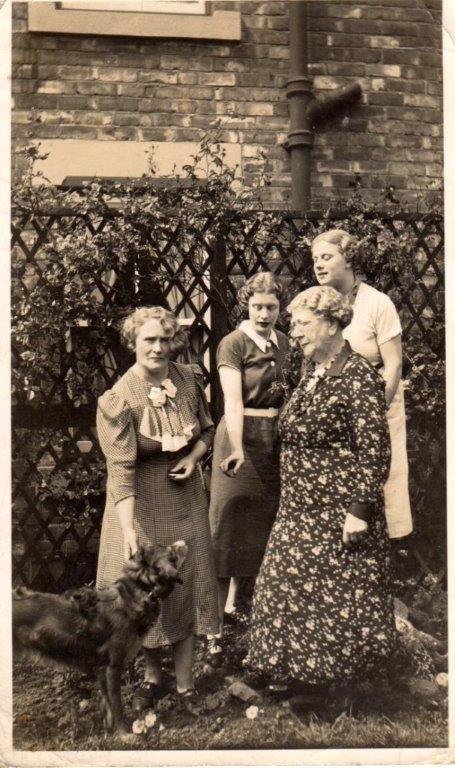
Beatrice (Great Gran), Joyce (Great Aunt),
Brenda (Granny),
front: Sarah Ellen (Great, Great Gran)
or just a 'hunch'), Mum opens a new file.  The green 'Harrop Fold Country House Hotel' folders are labeled with surnames I've never heard of.  Every file contains a branch of family tree in a fan layout.  Each family member has a plastic wallet containing a record card, name, date of birth, marriage(s) (in the 1800's a marriage certificate determines the quarter a couple are married, not a specific date), date of death along with anecdotal stories/memories, factual or otherwise!

I'm like a celebrity on "Who do you think you are?", I've rolled up with everything set before me and I'm excited, a little emotional even.  There is a lot of information, much of it is the facts of ordinary lives, in different times.  Soon enough, I want to right the wrongs, delve into those tangents and continue to dig a little deeper.

Next: the story of Sarah Ellen Gray (nee Simpson).  I hope that my children, Tom & Emma, my brothers, cousins, nieces and nephews will be able to enjoy dipping in and out of these snippets and along the way, I'd like to think, we might pick up some more flesh to the bones of our story.


Wednesday, 28 August 2013

B-Minus

It's been a tense few weeks of being patient and preparing ourselves for failure.

After Janet's visit at the end of July it was great to have the distraction of a week salmon fishing in Scotland.  The bees were left to do what the birds and the bees do and hopefully re queen by our return.

We escaped for a lunch break with the bees on Friday 9 August, Janet dashed up to meet us, having experienced her own war against nature; wasps who are making a nuisance of themselves and bees robbing honey from her other bee hives.  We lit the smoker and confidently bathed the bees in a gentle plume, however, things soon got a bit uncomfortable.  Bees were bumping our veils and John's gloves were being hammered by bee stings, fortunately none finding their way through.  We puffed in plenty of smoke to continue our inspection and though we couldn't spot a queen there was evidence of brood.  Verdict: Hive 1 either has no queen or an 'angry bitch' quotes Janet.  Hive 2 was a little calmer with plenty of brood and pollen.  It's a waiting game.

Two weeks later and John and I decide to brave our own independent inspection.  We have decided our purpose: to check for brood, hopefully spot a queen, replace a brood box which is split, add dummy boards at each end for winter warmth and insert entrance blocks so the bees can defend themselves better from wasps.

We set off in Hive 1 ready to cut and run if we are ambushed.  However, the bees seem relatively un-phased by our presence - surely this must be a good sign?  Slowly John lifts each frame while I scribe what he sees.  Every so often we think we have spotted the queen but then accept we've been fooled by a drone (male) bee.  We see plenty of brood, larvae, honey capped and uncapped and an exciting moment watching a newly hatched bee emerge from a cell.  

In Hive 2 the future is looking even brighter and the top supers feel quite heavy.  Hopefully we haven't blundered about too much while replacing the split brood box where the queen is most likely being protected by her worker bees.

Despite our 'schoolboy errors' we're feeling quite upbeat and very deserving of a cup of tea and a chocolate beetroot bun!

Bee fact 1: A smoker should be used sparingly, smoke doesn't calm the bees, when bees smell smoke their natural instinct is to prepare to flee.  In the wild smoke would only mean one thing….  Fire!  They immediately start to gorge themselves with honey. If they find they have to leave their nest and relocate to somewhere safer they will then have sufficient reserves to tide them over until their new nest is located and set up.  

Wednesday, 24 July 2013

Plan B!

I received a lovely email from Janet yesterday and immediately sent her back a virtual hug!  Wouldn't it be great to have this step by step advice during certain times of having teenagers?

"Hope yesterday wasn't too daunting with all the bees, you're both doing really well under difficult circumstances, and I noticed how calm you appeared to be when handling the bees.  Many people would have refused to go into such a large hive.

Anyway because I threw a lot of info at you I thought if a did an action plan for the next few weeks it would give you an idea of how to tackle things
1.  Leave the bees alone until you come back from holiday except for watching the entrance for bees bringing back pollen.  If you go into them too much at this stage of them rearing a new queen you may cause her to abscond.

2.  When you return let me know and I'll come up and help you go through them again.  By then you should have new queens in both hives.  If not we have to check for laying workers, but the bees know what they're doing in spite of us beekeepers!!  We will need to mark the queens if we can find them (won't be easy in the big hive) so it will be easier for you to see them when you’re doing your own manipulations. We also need to check their supplies; I suspect there won't be much honey as the swarm will have taken half.  In addition we'll put varroa test trays underneath to monitor the daily mite drop.
3. If food supplies are low you will need to feed the bees in time for them to process it before the weather turns cooler otherwise the syrup will ferment or crystallise and could cause the bees to have dysentery through the winter months when they can't get out.

4. If varroa treatment is needed it needs to be done before the temperature drops below 14 C
5. The equipment you will need to have ready in case we need it is as follows:
  • Feeders - one for each hive  (the round plastic ones are good and fit over the hole in the crown board)
  • Empty super box - one for each hive to fit the feeders in.
  • Varroa test trays - one for each hive ( National size) - you may have got one with the hive you bought
  • Varroa treatment - Apiguard or Api Life VAR are good. Two packs are needed for each hive to complete one treatment - Thymol based
  • Api eke -  one for each hive.  This is similar to a super but much smaller - about 2 - 3" high which gives space for the Apiguard treatment.  Easy to make yourselves.  The Api Life Var treatment sits on top of the frames in the brood boxes so no eke needed.
This is winter preparation - the start of the beekeepers year!  to ensure you have strong healthy bees going into the winter months and plenty of food to see them through it.  One advantage of the swarming is that you will have young strong queens going into winter/spring for next year.

All this equipment can be bought from Thornes and its not expensive and if not used will store till next year, but it’s better to have it so if necessary can be used immediately.
One other thing I noticed the brood box frames are pretty dirty and need changing otherwise disease will be carried from them.  This is done in the spring when the number of bees is smaller and there are empty frames which can be removed.  Ideally you sort out a system for changing about 3/4 frames a year in rotation so over 3 years all brood frames have been changed.  But winter preparation will include building enough new frames for this (not putting in the foundation until needed).  This can be done through the winter on quiet evenings when we are snowed in and there's nothing on telly!!!"
 

Sunday, 16 June 2013

Two bee or not two bee

After months of disappointing and frankly, depressing winter bee stories, suddenly there is a buzz in the air, just as we were about to set off to listen to the hum of a different kind at the Isle of Man TT Races.  Northern Bees phoned to say our bees are ready for collection from Ripon.  On the same day, local bee keeper, Janet, who guided me through the six week basic bee keeping course, rang to tell me that a friend of hers, Ian, who is relocating wanted a new home for various hives and bees.  

We met Ian last Sunday for a free apiary masterclass (bee keepers are certainly always keen to share their knowledge), on Tuesday we meandered to Grindleton at around bee bed time, 8.30pm.  Being the owner of a suitable car with the height for a hive stack, Dad was designated driver.  Ian guided John and I through every precise process of moving a hive until it was securely in the car, then cheerily said "they're yours now!"  John and Dad, drove back steadily, windows down, wearing suitable bee keeping attire (just in case) bearing their cargo like a china tea set.  

Ian has three hives including thriving bees for sale.  One is a big healthy colony, but probably a bit advanced for us newcomers.  After helping us settle the bees in their new location we discussed with Ian the possibility of taking a second hive from him.  

An early call to Northern Bees the next day proved more than helpful (plus another 40 minutes advice).  With demand from their customers exceeding supply, they positively encouraged us to take the local hive.
Emma came home to the 'funny farm' for a week off - John had her calling him at the office with regular bee sightings and chick updates since it's also now time for them to venture outside.


Bee Story : Ian said 'good bye' to his bees and told us according to old folklore, apparently you must tell the bees if their keeper has died.  

He knows of a lady who, upon her husband's passing addressed each of his bee hives and on each pinned a black ribbon.  On the day of her husband's funeral the bees swarmed on their former keepers grave.  


Sunday, 21 April 2013

Spreading the risk

Whether it was the shock of losing the coup that has spurred on Heinz 57 or maybe it's just that spring is in the air; she is broody.

Since our fox break in we've been leaving our eggs to accumulate in the nest box. When John went to the cabin to let them out last Thursday morning, Heinz 57 chicken was sitting, her wings spread protectively over the eggs.

John has converted Emma's old rabbit cage into a suitable brood box to give Heinz 57 the peace she needs away from Kelvin & Mrs.

We certainly don't have our eggs all in one basket - with our little egg stash in Clitheroe and our hensitting at home, surely something will deliver?


Saturday, 13 April 2013

The Birds and the Bees

So, to recap, at 1.30am on Wednesday morning I lifted from my sleep to the sound of strangling pain.   Listening intently I realised it wasn't the sleeping sounds of my husband, but a tormented chicken.

"The chickens are being attacked" I shouted as I ran down the hallway, throwing on my dressing gown and grabbing my wellies at the bottom of the stairs.  Though as we ran down the garden I did just wonder if I might just have been dreaming.

John shone the torch into the pen and spotted the first corpse.  In all the years I have lived at Harrop we've always had hens and never any sightings of a fox near the homestead.  We tend to view locking the chickens away as a fairly academic exercise and on Tuesday night we were guilty of missing the routine.

We lost two ex-battery hens and two bantam Rhode Island Reds.  Kelvin the cockeral was panicky but survived along with one Rhodie and the Heinz 57 chicken which we found in a tree the next morning.  On the positive side, at least the two ladies were able to make a successful escape out of the unlocked hatch.

In anticipation of more successful animal husbandry, Wednesday evening was the first class of my six week Basic Beekeeping course at Grindleton Pavillion.  There's not much more depressing than listening to the pitfalls of bee disease and no one is optimistic of getting bees locally this year, if at all.  This reflects in the price of bees, at a sale in the Midlands this week, each queen and colony were selling for £280.  In the bee world hope is  pinned for a turn in the weather and (the thing John and I most dread) swarms, from which, when managed well, bee colonies can be divided to create more hives.  (That's a very simple interpretation I should not use in my exam!)

Meanwhile, Craig, who originally supplied us with the Rhodies and now keeps Old English Game, suggested we collect all the eggs we have and take them down to him, as he has a clucky hen.  John asked what temperature they should be, Craig's technical response is "chicken arse temperature!".

There we have it, with nothing to lose and all the information we need, we'll let you know if we hear the pitter patter of tiny shells in 21 days time!